
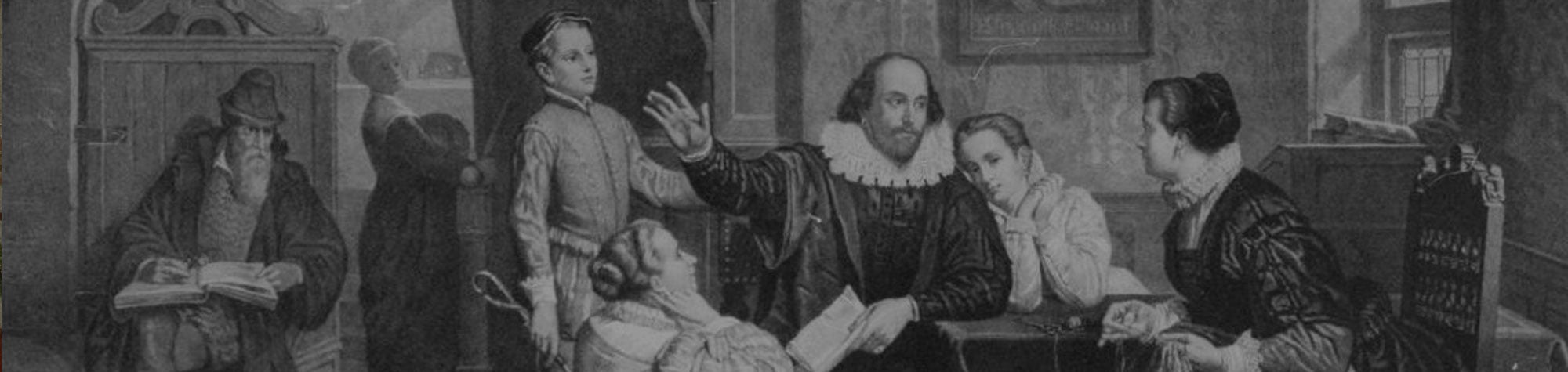
A BRIEF HISTORY OF THE BARD AND HIS LEGACY
You have probably seen countless movies or shows from your home theater room that were inspired by the works of William Shakespeare. More than 400 years after his death, William Shakespeare remains one of the most fascinating and mysterious figures in literary history. Despite being arguably the most celebrated writer in the English language, surprisingly little is known about the man himself. Most of what we have comes from a handful of official records: a baptism entry at Holy Trinity Church, a marriage certificate, the birth of his twin children, and documentation of his career as a playwright and actor. Beyond those milestones, the personal details of Shakespeare’s life, especially his childhood, remain largely a mystery. And yet, what he left behind speaks volumes. His sonnets, comedies, tragedies, and historical plays have endured across centuries, captivating audiences and scholars alike and cementing his legacy as the Bard of Avon.

THE EARLY YEARS
The exact date of William Shakespeare’s birth and death are uncertain, but tradition indicates he was born on April 23, 1564 and passed away on his birthday, April 23, 1616. It is unclear whether this is a romantic notion or fact. If the dates are wrong, evidence shows that they were close to the accurate days. Shakespeare was baptized at the Holy Trinity Church Stratford-upon-Avon on April 26, 1564. He was interred at the church on April 25, 1616. Exactly where William Shakespeare attended school is also unknown. Due to the fact there are no records of Shakespeare having attended a university, some argue that Shakespeare did not author his works. Some suspect that Shakespeare simply did not have enough education to have produced the beautiful odes, sonnets, and plays that bear his name.
Information regarding William Shakespeare’s early years includes his parents’ names: John Shakespeare and Mary Arden Shakespeare. Church records show that Shakespeare was the third child out of eight. Three of his siblings had passed away during their childhoods. The exact grammar school young William attended is also up for debate, and point to Shakespeare’s advanced knowledge of Greek and Latin to indicate he may have attended a free school. Information regarding the remainder of Shakespeare’s childhood is unknown.
FAMILY & RISE TO FAME
On November 28, 1582, William Shakespeare married Anne Hathaway. On May 26, 1583, the couple’s first child, Susanna, was born. Approximately two years later, on February 2, 1585, the Shakespeares welcomed twins into the world: Hamnet and Judith. Tragedy would befall the family and on August 11, 1596, at 11-years-old, Hamnet passed away.
It is estimated that Shakespeare first started working as an actor and playwright in 1588, and by 1594, Shakespeare had grown in prominence and worked with the King’s Men, a popular London troupe, which would become the most successful. William Shakespeare is one of the rare individuals who enjoyed the fruits of his success while still living. As a writer, Shakespeare enjoyed tremendous fame and success that continues to surround him more than 420 years later. William Shakespeare is revered as one of the world’s greatest writers.

LEARN MORE
Visit the resources below to learn more about William Shakespeare.
- A History of Opera
- This New York Times article discusses history and the development of the opera, while referencing a book by Carolyn Abbate and Roger Parker.
- A History of Opera: The Seductive Power of Song
- The Telegraph goes into detail about the beauty of opera, stating that the voice is the element that progresses it.
- A Timeline of Opera
- Oxford gives a detailed timeline of opera history.
- The Opera: A History
- The Met details art history through the years.
- Early History & Development of Opera
- This site explains opera, its origins and key elements.
- Introduction to Opera (PDF)
- Inquiring minds will receive a detailed explanation about opera and its many features.
- Opera Composers
- Stanford provides a list of noted opera composers throughout the years.
- Opera Pronunciation Guide
- It pays to gain an understanding of opera. This site provides pronunciation guides and historical information on the art.
- Italian Composers
- Opera historians can read profiles on the greatest classical opera composers, including Bellini, Corelli and Donizetti.
- Top 50 Operas
- The Guardian profiles the top 50 opera works of all time.
- 100 Best Opera Classics
- All Music provides a list of the 100 best operas of all time.
- Top 10 Opera Houses
- The magazine travels to Italy, Germany, Argentina, England, Russia and other locations in order to pinpoint the best opera houses in the world.
- 10 Greatest Opera Houses
- This travel and leisure publication details a number of excellent opera houses throughout the world.
- Great Opera Houses of the World
- Pertinent information about the best opera houses throughout the world.
- Development of Opera (PDF)
- An in-depth article about the development of opera as well as opera singers.
- Biography of Pavarotti
- A biography of Luciano Pavarotti, one of the most commercially successful opera singers of all time.
- Maria Callas
- A biography of Maria Callas, a famous Greek opera singer in the early 1900s.
