

The Globe Theater
—it brings to mind stage plays, Shakespeare, and London.
It’s one of those classic theatrical buildings, taking its place among the likes of the Sydney Opera House, the Bolshoi, and the Palais Garnier. Theater and stage performances have long been important sources of entertainment and enjoyment, and Shakespeare has been a king of the realm of theatrics for centuries.
Most people are familiar with at least one or two of Shakespeare’s plays, from Romeo and Juliet to Much Ado About Nothing, and many have seen productions on the stage. Shakespeare’s plays have been adapted time and time again, going from the traditional script to new twists for a modern audience, all while maintaining those beloved Shakespearian twists. But what about the theater that originally housed these classic productions?
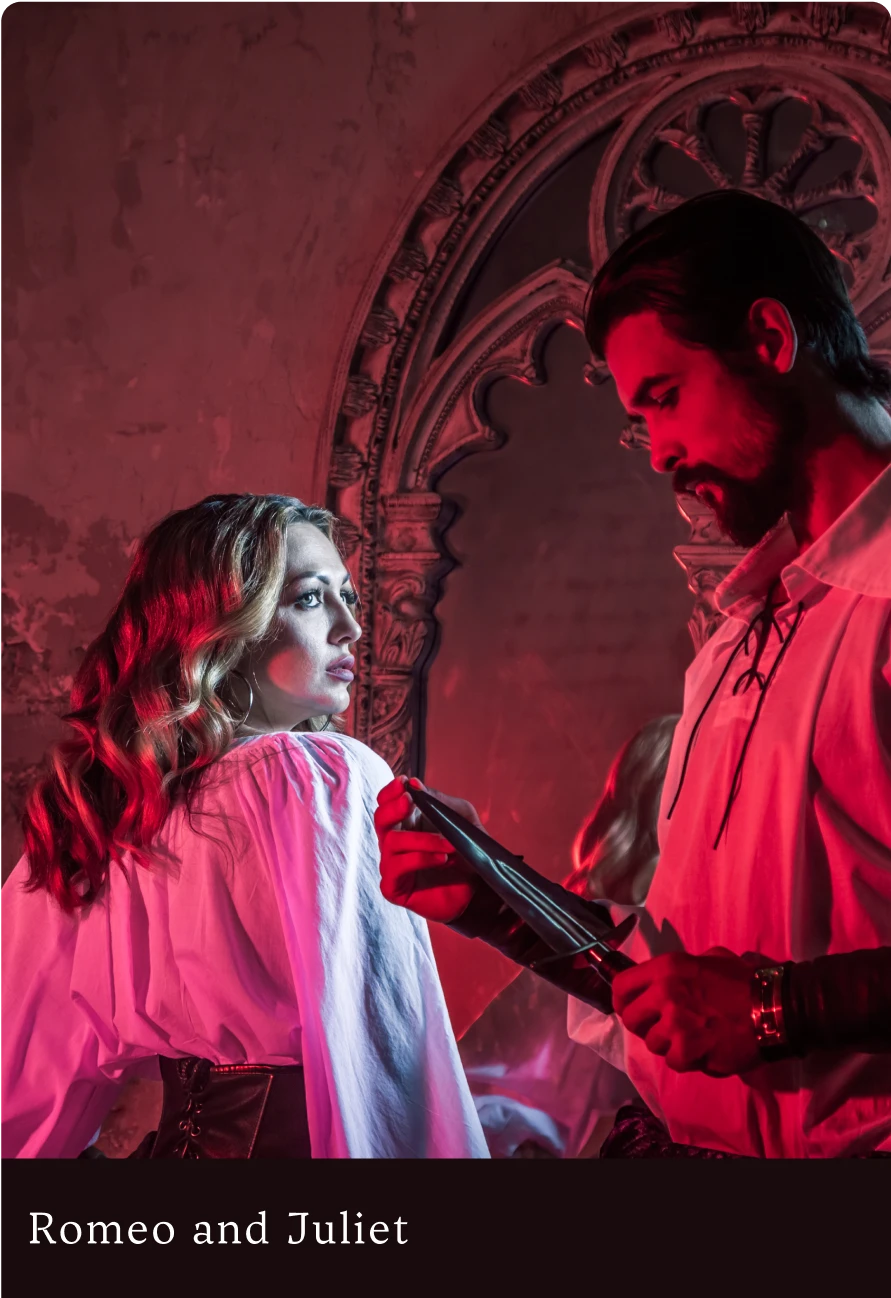


The Globe Theater was an institution for Shakespeare and his works for years on end and has a fascinating history.
From the Bard himself to his plays and his theater company, the life of the Globe Theater has been an exciting ride through one of the most famous and prolific eras of the history of the arts. Read on to find out more about the Globe Theater, its history, and the people and performances it housed.
A Brief Introduction to Theater and Shakespeare
From the Bard himself to his plays and his theater company, the life of the Globe Theater has been an exciting ride through one of the most famous and prolific eras of the history of the arts. Read on to find out more about the Globe Theater, its history, and the people and performances it housed.
Early Theater
Theater, or some form of dramatic acting, has around since time immemorial. From the earliest cultures of the Egyptians, Etruscans, Hittites, Israelites, Persians, and the later Greeks and Romans, the idea of theater can summon images of amphitheaters and elaborately masked actors.
With the blessing of Dionysus, the god of wine, fertility, and revelry, Greek theater enjoyed centuries of popularity and prolific scriptwriting by the greatest playwrights of the time.
Sadly, only 32 of these titles have survived today, by the top three names in Greek theater:
But even this selection gives us a good idea of the most popular tragedies of Greek theater from the late 6th Century BC onward.
While the Greeks favored tragedies such as Antigone, Clytemnestra, or Medea, the overpowering majority of Romans preferred to view comedies like Pseudolus and Miles Gloriosus. This shift in public appreciation sparked a dynamic split between the two genres and styles, beginning around the 3rd Century BC when two Roman playwrights began to borrow ideas from Greek drama and reproduce them into comedies that, oddly enough, were typically set in Athens.
Playwrights Plautus and Terence relied on Roman archetypes and ridiculous situations to get laughs, such as-
English
Swaggering soldiers
Irritable old men
Flatterers
Young men in love
Clever slaves
Prostitutes

Roman archetypes
mīlitēs glōriōusī
senēs irātī
parasītī
adulēscentēs amātōrēs
servī callidī
meretrīcēs
However, Roman audiences were not as enamored with theater as the Greeks had been, so plays began to be produced in tandem with the broader events of the Roman Games.
Theater in the British Isles
The beginnings of theater in England mainly evolved out of church services in the 10th and 11th Centuries AD, as dynamic sermons focusing on morality and the eschewing of evil. But by around 1350, the form began to come into its own when religious leaders promoted the staging of “mystery cycles” and “morality plays”—stories directly from the Bible, and tales about the lives of the saints and their miraculous works.


Aimed to spark God-fearing sentiments and greater allegiance to the Church, these early plays were written and performed in the common vernacular instead of Latin, which was still used for religious literature. The choice of the common language was able to reach more of the general public, who were largely illiterate at this time, and teach them about the Bible, God, and Christianity.
The Dawn of English Secular Theater
Despite its religious roots, secular theater rose to prominence in England following the Reformation in the early 16th Century.
Martin Luther’s epic movement against the authority of the Roman Catholic Church succeeded and suppressed specifically religious drama across the British Isles.
Just a few decades after this, in 1576, Britain’s first playhouse was constructed by James Burbage and aptly named “The Theatre [sic]” in Finsbury Fields, Shoreditch, London. This was the first-ever permanent playhouse in England and would go on to house the beginnings of Shakespeare’s works and his theater company, Lord Chamberlain’s Men.

The Theatre made in 1576 by James Burbage
Over the next nearly two decades, another 17 public, open-air theaters were built in England, and theatrical companies flourished under the patronage of titled nobles who lent their names to the troupes.
Writers were expected to produce a certain number of plays annually to satiate demand, and crowds flocked to the nearest stages. But with such great popularity, some theater companies became bitter rivals in the world of performance and writing, generating controversy that only fueled the adoration of audiences further.
The Playwright Himself: Shakespeare
The Bard lived during the perfect era to be a famous playwright. Born in 1564 at Stratford-upon-Avon, in England’s Warwickshire, William Shakespeare is remembered as the most famous playwright of the British Isles. His works span genres, themes, historical events, and myths, including 38 plays and many sonnets.
Known for his innately cohesive grasp of narrative and dramatic application, Shakespeare’s work incorporates notions of beauty, the inventiveness of language, and a remarkably universal outreach to all audiences.
Although his personal and family life is largely unknown, Shakespeare appeared with a flourish in the London theater scene in 1592, where his early plays first emerged on stage. These titles included Henry VI (parts 1-3), Titus Andronicus, and The Two Gentlemen of Verona, earning him a passive-aggressive review from a fellow playwright, believing that he was punching above his weight.
But this didn’t deter Shakespeare, and after 1594 his plays were performed exclusively by the Lord Chamberlain’s Men troupe of which he was a part, and that quickly became the leading play company in all London.
The Lord Chamberlain’s Men
Though this theatrical company was active before Shakespeare joined, their fame was assured once his writing skills were attached exclusively to the troupe.
Founded originally around the 1560s under the name Hunsdon’s Men, their patron Henty Carey eventually became appointed to the office of Lord Chamberlain and by mid-1594 the troupe was subsequently known as the Lord Chamberlain’s Men.
The company rose to immediate popularity and played many public stages, including the original establishment The Theatre. Within a few years, upon the death of Queen Elizabeth I, the newly crowned King James I adopted the company under his royal patronage, and they became known as the King’s Men from 1603 onwards—one of only two leading companies in London at that time.
King James I named the theatre company as The King’s Men from 1603
The exact date Shakespeare joined the troupe is debated, but the first financial listing of Shakespeare as a leading player was documented on March 15, 1595. Shakespeare quickly became the troupe’s sole writer, and even acted in the company, though the primary performer was Richard Burbage.
The youngest son of James Burbage who constructed The Theatre, Richard Burbage was seen as the greatest actor of his day and portrayed most of Shakespeare’s famous protagonists—including King Lear, Marc Antony, Othello, Macbeth, and Hamlet.
Though it seems that Burbage and Shakespeare had their creative differences, the remaining ten men and four boys of the Lord Chamberlain’s Men were essential for other roles, including those of women. The company soon held the exclusive rights to Shakespeare’s works, as performed on the brand-new stage that was about to be built—The Globe Theater.
The History of The Globe Theater
Many will immediately associate The Globe Theater with William Shakespeare, and not wrongly! This famous landmark of theatrical history is as quintessentially a part of London’s past as Westminster Abbey, the Tower of London, Kensington Palace, and the Houses of Parliament.
The Globe Theater itself was built by the members of the Lord Chamberlain’s Men and owned by the major shareholders of that theatrical company, with actors Richard Burbage and his brother Cuthbert Burbage holding the primary amount.
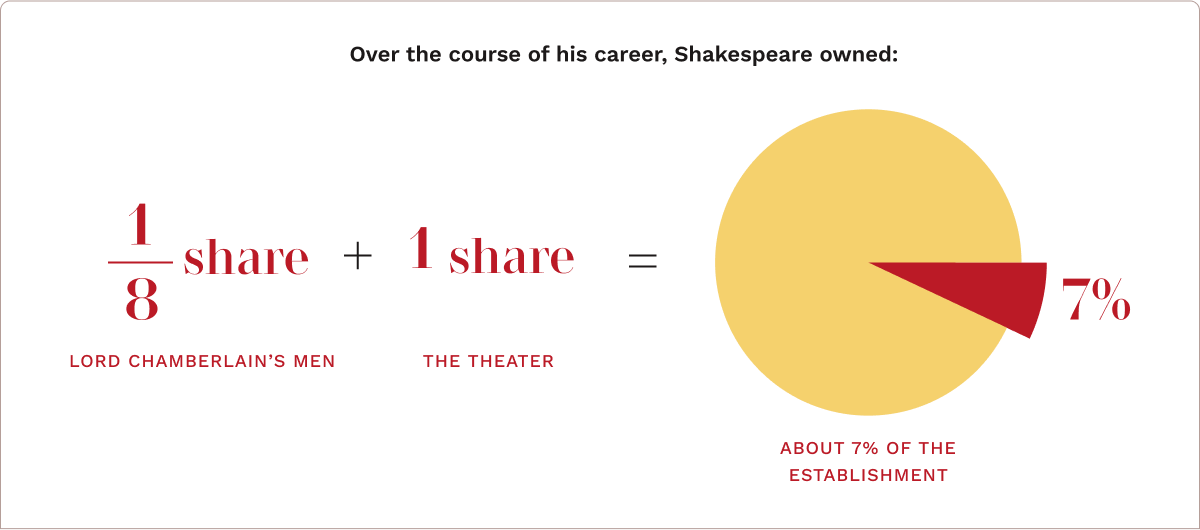
Shakespeare himself owned a one-eighth share in the Lord Chamberlain’s Men, and one share in the theater, though over the course of his career that share changed to leave him with owning about 7% of the establishment.
Origins of The Globe
The story behind the Globe Theater’s construction is intriguing right off the bat. After The Theatre, Britain’s first playhouse, went through extended issues between the Puritan landlord and building’s owners, the Burbages, it was eventually closed.
And in a controversial and vaguely agitational move, during the night of December 28, 1598, and in defiance of the landlord-

December 28, 1598
The Burbages hired a discrete carpenter to dismantle the entire theater and set the materials aside to be ferried over the River Thames when the weather was more clement.

Spring of 1599
And in the spring of 1599, those very timbers were reused to erect the Globe Theater itself on the south bank of the Thames, off of Maiden Lane in Southwark.


May of 1599
By May of 1599, the brand-new Globe Theater was ready for its opening summer production of Henry V, and Julius Caesar in September 1599.
Around 3,000 spectators
Gathering in vast crowds to take in the growing popularity of Shakespeare’s plays, the Globe Theater was an expansive building, allowing for around 3,000 spectators in a semi-circle around the center stage.
After the explosive success of the theater’s venture, Shakespeare was soon able to purchase a large house in his hometown of Stratford-upon-Avon for his own family, and even loan money to his close friends and contemporaries in the art world.
Within the mechanics of running, performing, and writing for the theater troupe and their new theater, Shakespeare was able to cultivate a distinctly unique relationship with his peers and fellow actors.
Individual actors’ personalities and the specter of the Globe itself shaped the characters and ambiance that he created, allowing for more diverse casting, expansive settings, and intricate backdrop and prop changes.
In this way, the actual building of the Globe itself played a great part in Shakespeare’s performance content, functioning as his personal playground to be transformed into the Three Crones’ cave, the battlefield of King Lear, or the lovesick balcony of Juliet.
The expanse and personal connection of the Globe’s stage was both muse and muscle for Shakespeare’s best works, and the acting talents of the Lord Chamberlain’s Men—and later, the King’s Men.
King James I, The King’s Men, and The Globe
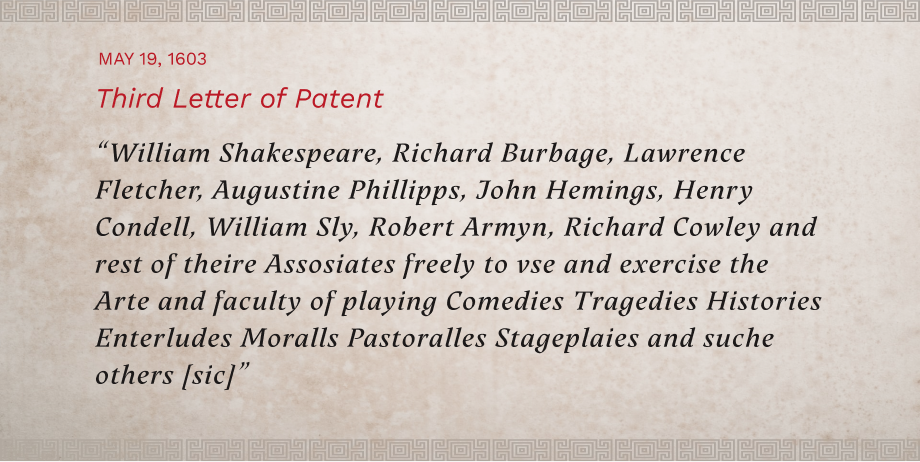
When Shakespeare and Burbage’s theater company was taken under royal patronage in 1603, King James I issued a new Letter of Patent under his signet that authorized the newly dubbed King’s Men and their theater, the Globe, by “special commission.” From that moment of enrollment, the entire company of former Chamberlain’s Men became one of only three companies patronized by the Crown, and the new Globe Theater was completely their own.
This Third Letter of Patent acknowledged by name William Shakespeare, Richard Burbage, Lawrence Fletcher, Augustine Phillipps, John Hemings, Henry Condell, William Sly, Robert Armyn, Richard Cowley and the “rest of theire Assosiates freely to vse and exercise the Arte and faculty of playing Comedies Tragedies Histories Enterludes Moralls Pastoralles Stageplaies and suche others [sic]”, and is dated May 19, 1603.
Further in this Patent, King James I decreed the players were to perform “within theire nowe vsual howse called the Globe within our County of Surrey…as you tender our pleasuree [sic].”
And so, the Globe Theater became the Crown-approved home of Shakespeare, the King’s Men theater company, and all the Bard’s immortal titles that we now know so well.
The Globe’s
Layout
Though the particular dimensions of the Globe Theater are not known, the general shape and size can be estimated. Between contemporary descriptions and artistic renderings of the Globe, and modern archaeological determinations of its foundation, we can extrapolate some information about the structure.
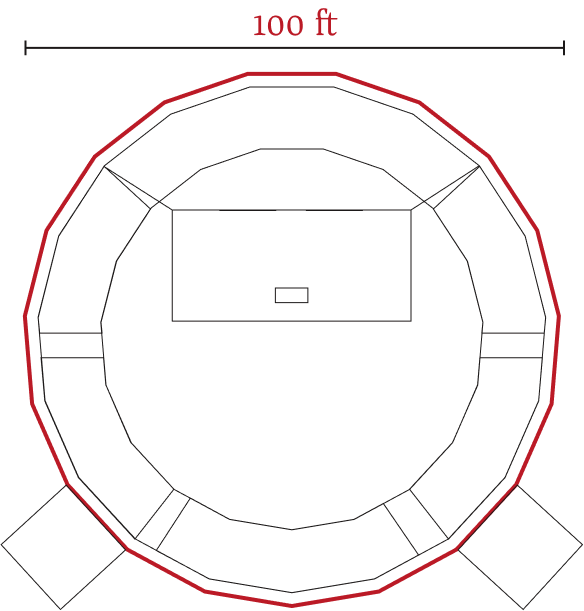
The original Globe seems to be an open-air amphitheater, as was common in public theater construction, with three levels of stadium-like seating to accommodate around 3,000 spectators.
The archaeological evidence suggests that the building itself was about 100 feet in diameter.
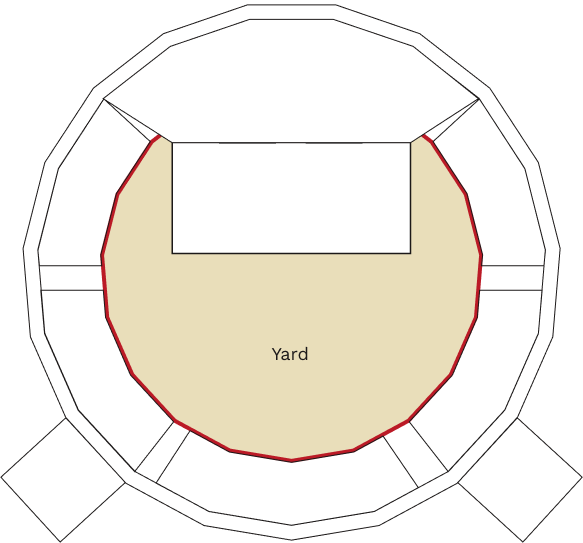
Situated within in the southeast corner of the building, the Globe’s stage took up a good portion of the ground level, at around 43 feet by 27 feet and elevated at 5 feet from the ground, extending into the outside wings like an apron stage. Being angled away from any blaring rays of the sun from the northwest, the stage was typically shaded by its partial roof even during summer afternoons. There was space surrounding the stage where, for a penny, people could stand on the bullrush-strewn earthen floor to watch the play.
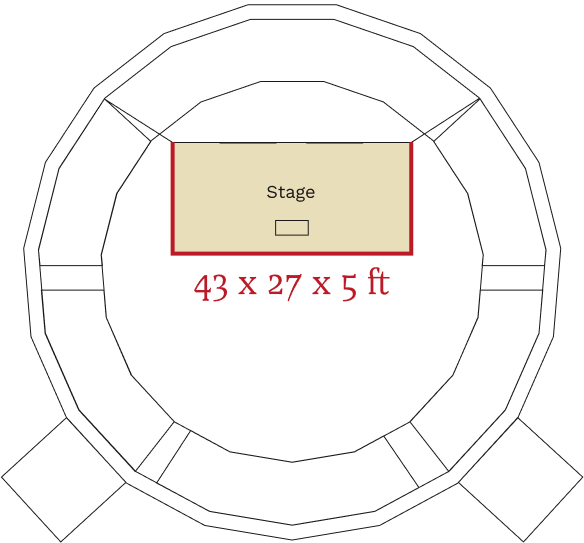
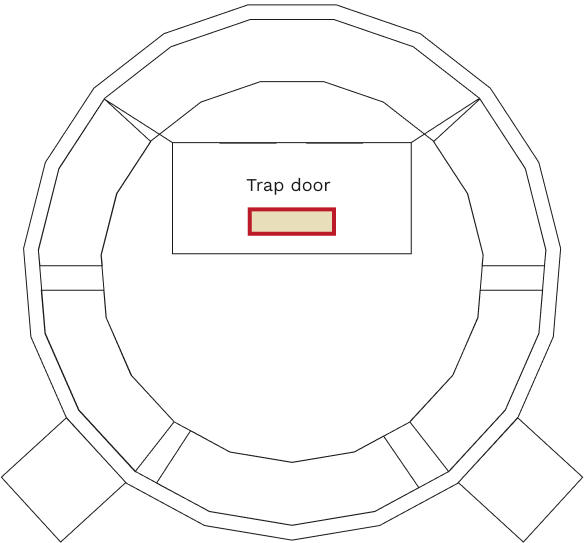
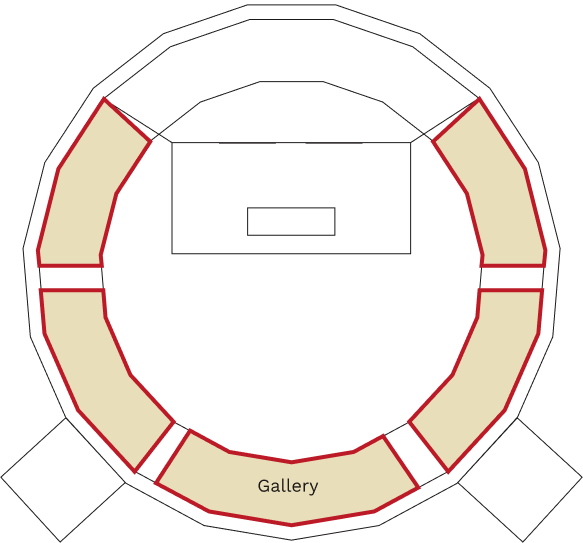
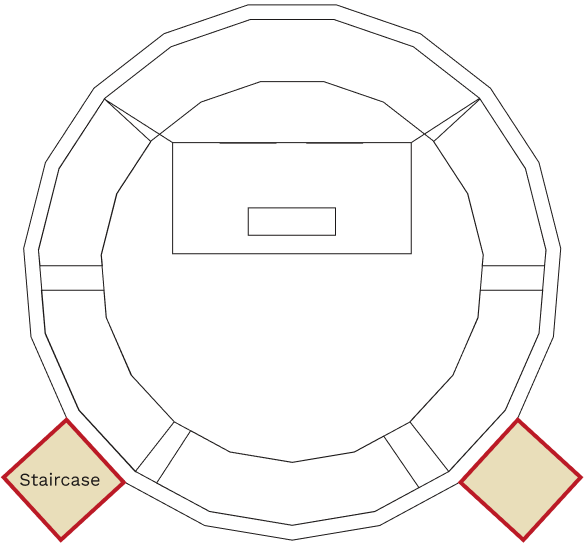
Below the theater, in a series of corridors and trap doors, actors and props could be brought up to the stage itself from the “cellarage” area beneath it.
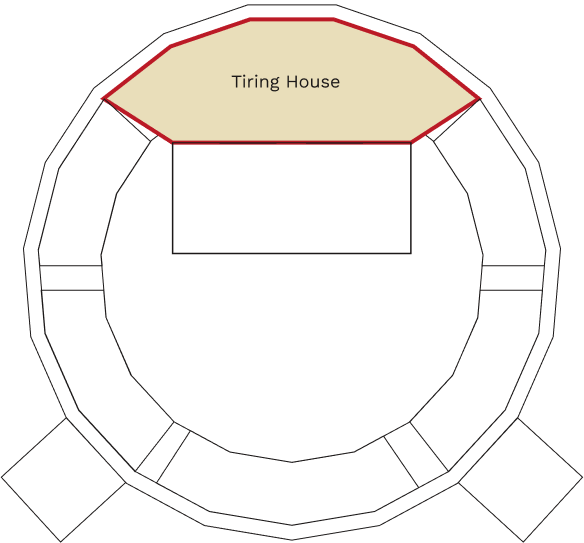
The partial roof hid primitive overhead rigging for stage effects and lifting actors or props. Backstage, rooms for changing and costume storage rested under a balcony where musicians played and could also be used for any scenes requiring upward space such as Juliet’s terrace.
The exterior of the Globe is easier to determine from various contemporary sketches of the sweeping Elizabethan cityscape of London.
Parts of the stage projected out into the wings of the exterior courtyard, and artists from Shakespeare’s time have labeled small outdoor buildings on the property as supply and food huts and more impressively, a bear-baiting enclosure, for “the game of Beares and Bulls to be bayted in the same and convenient Tyre house” as later theatrical entrepreneur Philip Henslowe would describe it in his diary.
What’s In a
Name: Why “The Globe”?
You may be wondering the genesis behind the theater’s iconic name—The Globe. The general consensus traces back to a Latin quote that was quite popular among the theatrical community at the time: quod fere totus mundus exerceat histrionem. This phrase roughly translates to “thus all the world has come to bear occupation for the actor,” or the more popular version, “because all the world is a stage.”

Its exact literary source is difficult to attach to a specific work by Petronius, as only some of the author’s writings survive, but scholars tend to agree it comes from the Petronii Arbitri Massiliensis Satyrici Fragmenta—specifically fragment 673.
A shortened version of the original Latin was said to be carved into the main doorway of the Globe Theater, along with a flag that featured the figure of Hercules lifting the Earth on his shoulders.
Some historians have speculated that the link between the Globe Theater and the idea of the world as a globe from the original Latin only came later in the theater’s history, but we cannot know for certain.
Regardless, it’s indisputable Shakespeare used the quote and rephrased it to create the famous lines from the play As You Like It:
“all the world’s a stage, and all the men and women merely players…”
(Act II, Scene 7, 139-140)
On the Stage: Famous Plays at The Globe Theater
While the Globe Theater housed numerous titles, the following are some of the most popular plays that we know and love today.
Written expressly for presentation on the stage of the Globe Theater, here are a selection of Shakespeare’s most famous plays and when they were performed:
The End of The Globe Theater
To quote Geoffrey Chaucer’s epic poem, Troilus and Criseyde, all good things must come to an end, and so did the Globe Theater’s grip on London’s theatrical scene. In fact, the Globe ended up closing twice before truly shutting its doors to the public and finally being dismantled on the heels of Puritan reforms.
Twice Concluded, Twice Shy: The Globe Closes Its Doors
June 29, 1613
The first closure followed an onstage mishap during a performance of Henry VIII, on June 29, 1613, when a theatrical cannon misfired during Act 1, igniting the theater’s wooden beams and roof thatching.
Thankfully, no actors or theatregoers were hurt, and the nearest to injury was an audience member whose breeches caught on fire and was summarily extinguished with a large bottle of ale.
February 1614
The Globe was immediately rebuilt for February of the following year, copying the incredibly swift original building time of just over six months
The Globe continued to function and hold performances without issue for the next few decades but was once again in danger in 1642.
Just after the First English Civil War had begun a Puritan-guided parliament ordered the closure of all theaters in London, citing feelings of “lascivious Mirth and Levity [sic]” prompted by public stage-plays, incompatible with the current “times of humiliation”.
Historians speculate this reasoning was a front for the real intention of making room for tenement buildings that would bring plenty of bureaucratical revenue, but we may never know.
1644-1645
In either case, the Globe Theater was finally and officially torn down in 1644-1645 by Sir Matthew Brend.
Thankfully, William Shakespeare was not present to see the final closure of his beloved theater—he had passed away on April 23, 1616, three years after the Globe Theater first burned down due to cannon malfunction, at the age of 52.
The Resurrection of the Globe Theater
But like a phoenix from the ashes (at times, literally when it comes to this theater), the Globe would rise again. After debates on the historical necessity and modern interest, the modern reconstruction of the theater was opened in 1997.
The theater was renamed “Shakespeare’s Globe” and rocketed back to cultural relevance with a production of Henry V, just like the first iteration of the Globe did back in 1599.
A Shiny, New Theater: Rebuilding the Globe
In 1970, Sam Wanamaker, an actor and director from America, founded the Shakespeare Globe Trust and the International Shakespeare Globe Center, with the goal of recreating the original Globe theater.
Even with concerns about the complications of 16th Century architecture designs, especially regarding safety concerns and fire hazards, Wanamaker and his dedicated team were stalwart in their vision, and with the assistance of historical adviser John Orrell, the new Shakespeare’s Globe was successfully completed.
It is important to note that the rebuilt theater is faithful primarily to the first iteration in 1599, while only using aspects of its 1614 replacement whenever absolutely necessary for guidance. After studies of other Elizabethan era buildings, such as The Theatre and other Bankside theaters included in Philip Henslowe’s diary such as the Rose Playhouse, the Hope Theater, and the Swan Playhouse. Of course, modernizations were necessary, such as the addition of fire sprinklers, disabled access support, and a lobby that houses a visitor’s center and a small museum.
Due to modern Health and Safety regulations, the original 3,000 seats for audience members were halved according to evacuation procedures, only allowing 1,300 people to be housed during a show.

And, like the original Globe, the theater is open-air, with three tiers of steeply raked seating. And just like in Shakespeare’s time, the area surrounding the stage itself is open to standing-only audiences—for 5£ each, instead of the original penny cost.
Because of the openness to the elements, Shakespeare’s Globe typically houses performances between May and October, with the remainder of the year devoted to educational pursuits, though tours of the facilities are available year-round.
Though many other replicas of the Globe Theater have been constructed across the world, including in the US, Germany, New Zealand, and Japan, Shakespeare’s Globe strives to continue the proud tradition of the Bard and his works.
Location,
Location,
Location
Based on an academic approximation of the Globe’s design and location, from both the 1599 and 1614 buildings, the new theater was placed about 750 feet away from the original location.

This new theater is located on the south bank of the Thames, at Bankside, Southwark, just like so many documents from the 1600s note the original Globe being instituted.
For anyone curious about taking a virtual tour of the neighborhood with such applications as Google Earth, the coordinates are 51°30’29” N 0°5’50” W, nestled between London Blackfriars, Mansion House, and London Bridge tube stations.
With the lovely view of the river and downtown London, not to mention the tourist-heavy location, the new Globe Theater is a popular stop for patrons of the arts, theater lovers, and travelers alike.
Offerings at The Globe
Not only does the new Shakespeare’s Globe house plays and performances, but it also hosts educational programs and historical re-enactments. Tours are available that immerse visitors into the world of Shakespearean England and what the experience of the original Globe Theater must have been like.
There is even an adjacent indoor theater modeled expertly after the Jacobean-era playhouses and their grandeur, used for tours, education, and winter-month performances, which is aptly called the Sam Wanamaker Playhouse.

Sam Wanamaker Playhouse
Family activities, immersive experiences, theater productions, and programs of all kinds continue to draw in the public and keep Shakespeare’s Globe Theater lively and bustling. One can only imagine that the Bard’s ghost is quite pleased with the outcome of all his work!
Fun Facts: Six Trivia Tidbits About Shakespeare and The Globe Theater

A History of the Globe Theater
From intrigue to resilience, the history of the Globe Theater is a fascinating exploration of Elizabethan theatrical history, and being irrevocably intertwined with the life of William Shakespeare, is an important figure in his own life and span of works. During its 45-year reign on the south bank of the River Thames, dozens of plays were housed, and countless crowds thrilled by the narrative prowess of Shakespeare’s writing. But the theater also had its ups and downs, as did the troupe attached to it—originally the Lord Chamberlain’s Men, later under the patronage of King James I as the King’s Men.
Yet this was also where Shakespeare the playwright flourished, turning the drama and pressures of the Crown into masterpieces that tackled contemporary issues through the lens of historic events, mythical fancies, or the yearning of innocence.
And even after the death of the Bard and the final closure of the Globe Theater, it was rebuilt in the 1990s and continues to enjoy popularity to this day, keeping the traditions and memory of Shakespeare and his theatrical company alive and well.
Useful Links
The Virtual Globe
An animated tour of the original Globe Theater from the University of Cambridge.