

Remember Kermit the Frog and Miss Piggy’s love affair? How about Fozzie Bear and his joke-telling? There was a resurgence of Muppet theater in the early aughts and 2010s thanks to the release of several Muppet movies. Since then, the Muppets have been streaming into home theaters delighting audiences of all ages as they come together on the sofa and loveseat set or in their power recliners with their bowls of popcorn. Kermit, Miss Piggy, and all the other Muppet characters are an example of puppetry. Puppetry is the act of giving inanimate objects life-like characteristics through the manipulation of a puppeteer. Puppetry can be useful in many ways. It is a great way to help students learn in the classroom. The focus is not on the student so they can relax and use their creativity in a dramatic activity. Puppetry allows theaters to bring objects to life on-stage that could not otherwise be used. For example, in the award-winning Broadway play Warhorse, the story is told from the perspective of an English farm horse who is actually an amazing puppet. As with other forms of pretend play, playing with puppets and putting on puppet shows in their home theater seating area allows children to work through difficult emotions and process events in their lives in a safe way. The next time your child wants you to sit and watch their performance, take the time to sit with them; you may be surprised at what they have to share.
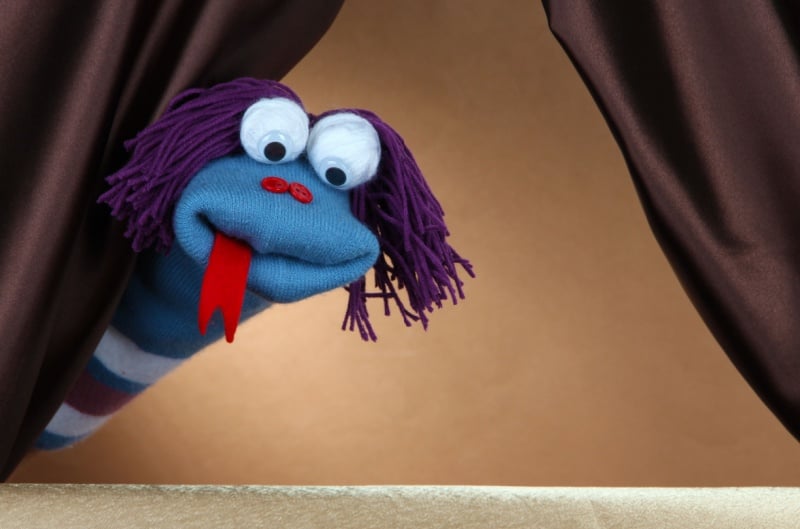
History of Puppets
Though no one can be 100 percent certain of the actual beginning of puppetry, there are some theories. Puppetry utilizes puppets, which are the objects manipulated by a person or puppeteer. Approximately one thousand years B.C. India was said to be its birthplace. Indian epics such as Maha-Bharata were acted out using stick puppets. The texts were very entertaining with the puppets, and the performances were very lively.
Indonesians used wayang puppets in their performances which began with a speech from a holy person. The performances had some seriousness to them. Wayang puppets can be round or flat. The wayang kulit is the flat type of puppet and is created from buffalo leather. Wayang puppets are used behind white screens that have black lights so they appear as shadows to the audience members.
Centuries later, bunraku puppets (Japanese puppets that were big and very expensive) were used to replace actors on-stage. Bunraku itself is actually a Japanese puppet theater where the performance is a combination of puppeteers, musicians, and narrators. The puppets of this era were very sophisticated and perfect for dramas concerning history and love stories. As many as three men could be assigned to each puppet while being hooded and clothed in all black. They were visible to the audience yet not acknowledged.
Puppetry was also popular in Europe where they could be utilized to act out plays focusing on morality issues that would not be appropriate to be acted out by people. In Italy, puppetry became very popular in the 18th century, particularly for serious plays.
Big changes happened to puppets during the 19th century. Pietro Radillo (a Venetian puppeteer) directed an upgrade which involved going from a mere two strings to as many as eight per puppet. This adaptation gave puppeteers more control with the puppets which led to a greater range of movement. This change made puppets more believable. In this century puppets began to separate from actor theaters and became similar to jugglers roaming the streets. Puppeteers were soon competing with music hall theater and vaudeville. Puppetry became very versatile and adaptable, and found its way to places such as seaside resorts.
Fast-forward to 2011, and puppetry has become very popular once again. Incredible puppetry is part of the musical “The Lion King” as well as “Warhorse.” Sesame Street characters (which are puppets) such as Elmo and Big Bird are still popular today and beloved by children throughout the world. As stated earlier, the Muppets are back!
- Puppetry in the Classroom – Puppetry Page discusses what puppetry is and how it can be utilized in a classroom.
- WVU’s Puppetry Program Puts Students’ Futures in Their Hands – An article by West Virginia University Today discusses degree programs in puppetry arts.
- Warhorse-the Puppeteers – Youtube video website shows the play “Warhorse” from the National Theatre.
- Introduction to Bunraku – The Japanese Performing Arts Resource Center explains what bunraku is.
- Wayang Kulit-Indonesian Shadow Puppets – This Discover Indonesia website describes what wayang kulit puppets are and how they are used.
Different Forms or Types of Puppetry
A very unique and fascinating form of puppetry is termed “water puppetry” and is native to the Vietnamese. The puppeteers are actually in a pool of chest-high water utilizing the surface of the water as the stage The puppets are figures made of wood which sometimes have jointed limbs, hands and heads. The puppet figures are attached to floating pontoons just below the water’s surface. This makes it seem as though the puppets are floating across the water. Long poles are attached to the pontoons for the puppeteers to use to push and pull the puppets. The puppet figures are hollow with rope inside of them attached to their parts that need movement. The ropes run along the poles the puppets are attached to and into the puppeteer’s hands. At least three puppeteers can be required to control each puppet. A bamboo blind is used as a screen to hide the puppeteers from the audience. The puppeteers are able to see through the blind while the audience cannot. A small percussion orchestra and a narrator accompany the puppetry.
A third form of puppetry found around the world is referred to as “wayang golek” and utilizes Indonesian rod puppets. This type of puppetry is also known as Javanese puppetry. The paintwork, carvings, and costumes are very elaborate with these puppets. The puppets tend to have long, thin arms and legs and very angular shoulders. The puppetry is often regarding mythological stories and historical events. The puppeteer uses rods from below the puppets to control them. Puppets for this type of puppetry are created from wood with the puppet’s body resting on a long rod manipulated from below. Rods are attached to the tips of each jointed hand. There are three rods in total that the puppeteer operates the puppet with including one for each arm and one for the body. The rod for the body runs all the way to the puppet’s head so the puppeteer can also control the head. A mostly percussion orchestra plays along with the puppetry which is performed at night with large lanterns.
- Glossary of Puppet Terms – The Wikipedia website defines many puppetry terms such as glove arm.
- Vietnamese Water Puppets – Sagecraft Productions explains Vietnamese water puppets.
- The Wayang Golek Theater of Java – This article explains wayang golek puppetry.
- Wayang Golek – This website sells wayang golek puppets yet also explains what they are and shows beautiful pictures of actual wayang golek puppets.
- Haridimos Karaghiozi Shadow Theater – This article on Matt Barrett’s Travel Guides website provides information on this particular karagozi puppet theater group in Greece.
Modern Puppetry
When people think of modern puppetry many often think of the Muppets or Sesame Street. Modern puppetry can also be found on Broadway such as in The Lion King. Unlike the puppetry of the Muppets, with the puppetry utilized in this production, the audience can see the puppeteers. The puppets are life-size and attached to the puppeteers. The puppeteer can manipulate the entire body of the puppet including its face. This helps to show emotion for the puppet. Because the puppeteers are visible to the audience, they too can lend facial expressions to the performance. For example, in this play, the character of Timon is a puppet. The puppeteer is dressed in all green including green hair and facepaint. The audience is therefore drawn to the puppet and not the puppeteer. The use of puppetry in plays really brings the characters to life.
Puppetry can also be used in conjunction with special effects for movies. For example, in the film The Muppet Movie special effects are utilized in addition to the traditional Muppet puppetry. Nvidia Quadro GPU’s helped alter various film frames and add realistic animation to the movie. The Muppets themselves remain puppets though. The puppets can do more incredible things thanks to the addition of special effects.
Puppetry Theater Education – Learn and Host a Puppet Show in Your Home Theater
If puppetry intrigues you and seems like something you would enjoy learning, there are universities that offer degrees in puppetry, as well as colleges that offer a few classes in the subject area. You can also find internships and workshops that are offered in puppetry. Puppetry scholarships and awards are also available if you are interested in something like that to help with your education. If you are interested in trying out different types of puppetry, a home theater production may be just the ticket to try your hand at it. Gather your friends and family in your home theater, on your sectional couch, or in their favorite home theater seat, and showcase your new found interest.
The following links will all provide you with much more information on puppetry educational options. Now is the time to discover the world of puppetry; a true historical art form.
- Ballard Institute and Museum of Puppetry – This article discusses the museum of puppetry as well as a nearby facility offering undergraduate and graduate degrees in puppetry. The museum’s location is Connecticut.
- Bachelor of Fine Arts-Puppetry/Creative Dramatics – This website discusses the degree and what is involved in it.
- Theatre Arts Department -Central Washington University – This university offers beginning and advanced puppetry courses as well as graduate courses for master’s degree candidates that include puppetry.
- UNIMA-USA Scholarships – Scholarships around the globe are offered via this website and the relative links.
- Great Arizona Puppet Theater – This puppet theater has puppetry internships.
- Eulenspiegel Puppets – This company offers both residencies and workshops in puppetry.
- Center for Puppetry Arts Program Offerings – Programs are offered for ages pre-Kindergarten to adult.
- Rhode Island School of Design – This institute offers some courses in puppetry.
- Central School of Speech and Drama – The institute in London offers two puppetry degree options.
- Dell’ Arte International – This school focuses on the exploration and development of physical performance and attracts students from throughout the world. It can be found in California.
Home Theater Seating
- Diamond Pattern Theater Chairs
- Power Recliner Chairs
- Black Leather Theater Recliner
- Oversized Recliner Chairs
- Custom Home Theater Seats
- Red Home Theater Seats
- Brown Theater Seating
- Average Distance Between Rows
- Berkline Home Theater Seating
- Theatre History
- Power Recliners With Adjustable Lumbar Support
- Movie Theater Chairs Home
- Raised Seating Theatre
- Best Recliner Sectional
- Leather Chair With Cup Holder
Decor & Accessories
- Home Movie Theater Room
- Movie Poster Frame
- Theater Room Sofa
- Carpet for Home Theaters
- Popcorn Machine Cart
- Home Theater Sound Panels
- Theatre Wall Lights
- Reclining Sofa Home Theatre
- Theater Marquee Sign
- What is Broadway Theatre
- Greek Drama
- Japanese Theatre
- Theater Seating For 3
- 6Pcs Recliner
- Slate Grey Recliner
- Theater Seats Hr Dream
Top Pages
- Cinema Seating
- Home Theatre Room
- 2 Piece Theater Seating
- Contemporary Leather Chairs
- 4 Theater Chairs
- One Person Theater Seat
- White Leather Theater Seating
- Top Grain Leather Recliner
- Sectionals Made in USA
- Auditorium Theater Seating
- Cinema Rug
- Curved Home Theater Recliner
- Recliners Chair Reviews
- Theatre Seats Fabric
- Sofa And Chaise