
Most people have enjoyed watching a film at the movie theater, but few people are familiar with the technology used to show their favorite films on the big screen. Movie theater projection has gone through several major incarnations over the years. The technology has evolved from the earliest projectors invented in the 1800s to 35 mm and large-format IMAX projectors and finally to the digital projectors used in most multiplex theaters today.
Early Motion Picture Projectors
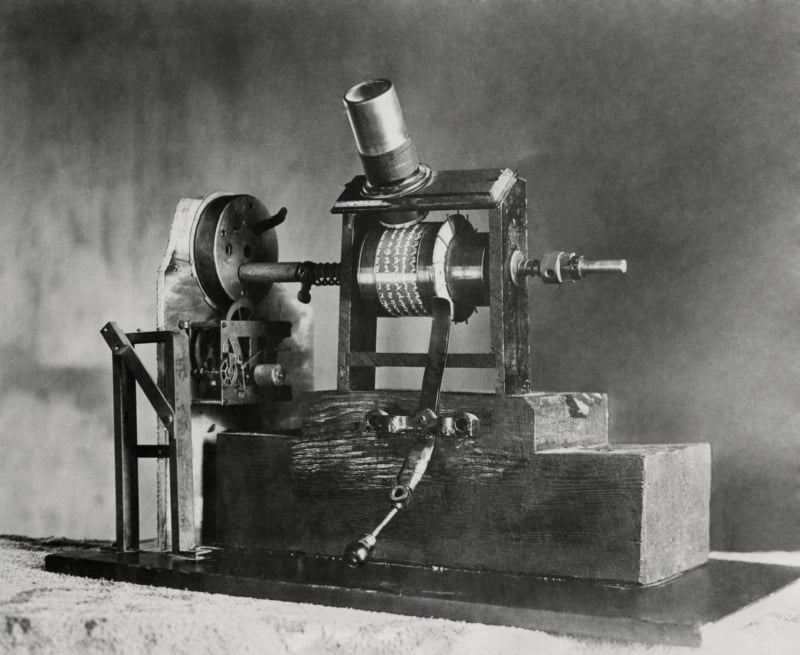
Thomas Edison’s Kinetoscope was the forerunner to the motion picture projectors we know today. Invented in 1893, the Kinetoscope displayed moving cinema images, but the images could only be viewed by one person at a time by looking through a small opening on the top of a box-like cabinet.
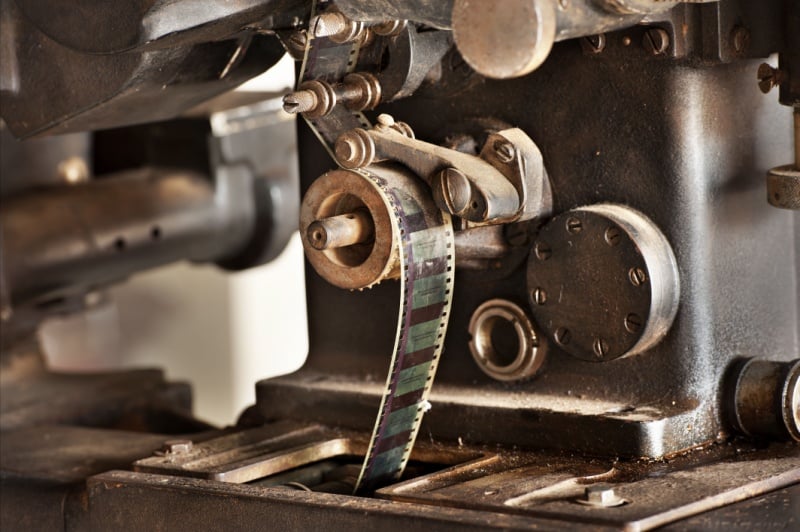
In 1895, Woodville Latham and his sons, Otway and Gray, unveiled their own movie projector, called the Panoptikon. Unlike the Kinetoscope, the Panoptikon could show larger-sized motion pictures to a group of people assembled in a darkened room, similar to the movie theater experience we have today. Woodville Latham and two former Edison employees, William K. Dickson and Eugene Lauste, are credited with creating the so-called “Latham loop,” which enabled film projectors to run smoothly for a longer duration of time without tearing the film. The Latham loop is still used in threading every film projector to this day.
Also in 1895, the Lumière brothers’ Cinématographe was unveiled in Paris, France. Auguste and Louis Lumière designed the Cinématographe to be a portable motion picture camera as well as a projector and film printer. The Lumière brothers’ invention was compact and hand-cranked, so it could be moved around easily to show the films they created to audiences. The success of the Cinématographe led to the establishment of movie theaters and the burgeoning motion picture industry.
All of these early projectors used 35 mm film, and by 1909, 35 mm had been adopted as the worldwide film industry standard.
Vitaphone and Movietone Sound
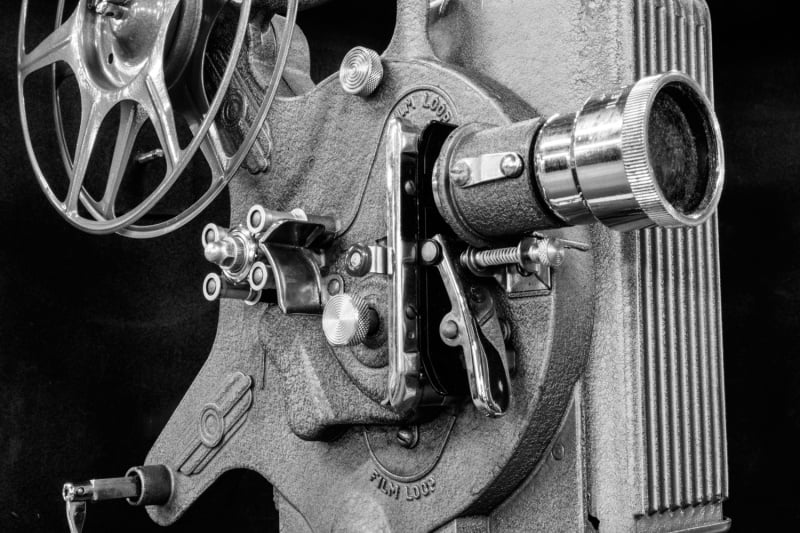
Up to this point, motion pictures were silent, with no synchronized sound. Several sound technologies vied for supremacy during the 1920s. The Vitaphone sound-on-disc system offered synchronized sound playback with a vinyl disc manually linked to the film projector. In 1927, the Vitaphone system was successfully used in the film “The Jazz Singer.” Unfortunately for Vitaphone, a competing sound-on-film system from Movietone ensured accurate synchronization of sound and image every time. Since Vitaphone used a disc system separate from the projector, it could not guarantee that the sound and picture would always be in sync. Movietone technology prevailed, and by the 1930s, all movie theater projectors were playing feature films with perfectly synchronized sound.
The 35 mm Projection Booth
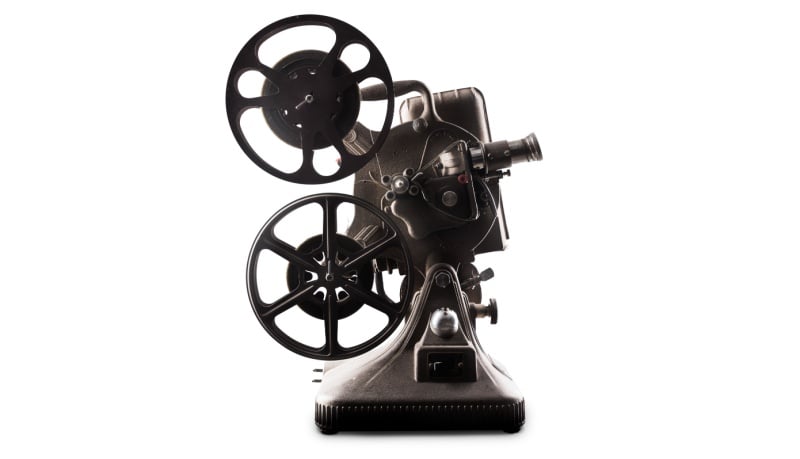
It took training and skill to be a movie theater projectionist. A projectionist was required to take care of the film and projection equipment and run the 35 mm projector during shows. For many decades, projection booths used a changeover system, where two 35 mm projectors were used in tandem to show one movie. Both projectors would be aimed toward the screen so the image could be projected through a small porthole window. A reel of film would be loaded on top of one projector and then threaded through the projector itself. As the film ran through the projector, it was rewound onto an empty reel below. The projectionist always had to be attentive, since every 20 minutes or so, it would be time for the changeover to the next reel. A two-part changeover cue was placed near the end of each reel to let the projectionist know when the reel on the first projector was about to end. The next reel of film would need to be loaded and threaded through the second projector. When the first changeover cue showed up on screen, the projectionist would need to start the second projector. As the first reel ended, the projectionist would open the shutter on the second projector so the movie would continue on screen in a seamless transition. While the second reel played through, the projectionist would have to get the next reel threaded and ready to go on the first projector. This procedure would continue until all reels of a film were played. Finally, the projectionist would have to rewind all of the reels before the next show.
Working in a projection booth could be a dangerous job due to the highly flammable nature of nitrate film. Mishandling of nitrate film could cause a serious fire in the projection booth, which could even spread throughout the theater. By 1955, nitrate film had been replaced with a much safer polyester-based film.
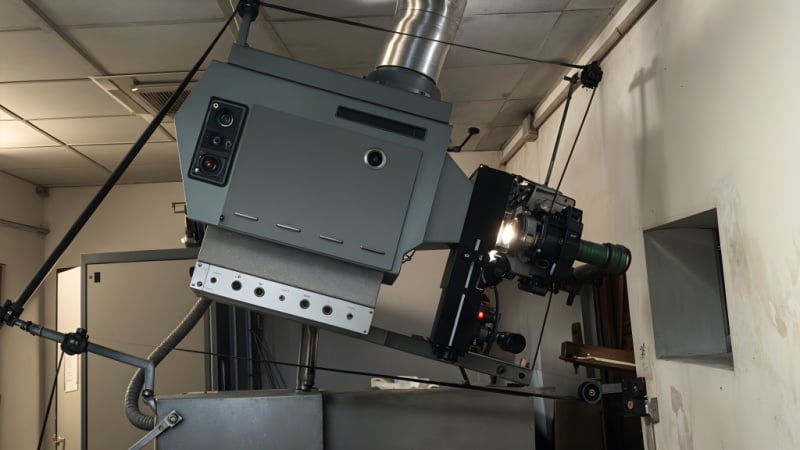
The next technological innovation in film projection occurred in the late 1970s with the introduction of platter systems. Unlike the changeover system, which required the projectionist to be in the booth at all times, using a platter system opened the door to automation. Projectionists no longer had to play each reel individually, alternating between two projectors. Using a platter system required the projectionist to splice all of the reels of a film together to create a single large reel. The large reel was then wound onto a round rotating platter located several feet from the projector. The platter was controlled by a payout mechanism, which fed the film through rollers attached to the projection booth’s ceiling and then down through the projector. As the film ran through the projector, the film passed through more rollers and would then be wound onto an empty platter. With this system, projectionists were no longer required to stay in the booth and constantly monitor the film, since the entire movie would play automatically. However, a trained projectionist was still needed in case of a film break or other technical emergency.
This type of automation led to the rise of multiplex theaters, which could showcase a wider selection of films and gave theater owners the opportunity to fill more theater seats in multiple auditoriums. The introduction of Dolby Stereo sound in the late 1970s and Dolby Surround sound a few years later further enhanced the movie viewing experience at multiplex theaters.
IMAX and 70 mm Projectors

Large-format projectors that could run 70 mm film also became more popular in the 1970s, giving moviegoers an immersive and visually stunning experience at the theater. Since 70 mm film is twice as wide as 35 mm film, it projects a larger image with higher resolution on screen. IMAX films are run with a specific type of 70 mm film and projector. While 35 mm and regular 70 mm film run vertically through the projector, IMAX 70 mm film runs through an IMAX projector horizontally. IMAX’s wider film frame running horizontally results in a much larger image on screen. Throughout the 1980s and 1990s, IMAX technology was exclusively used to fill seats for screenings of nature films and documentaries. By the early 2000s, IMAX DMR (Digital Media Remastering) was created to convert standard 35 mm films to the IMAX format. Multiplex theaters took advantage of this new technology and added IMAX screens and projectors to show the latest box office hits in IMAX.
Digital Projectors Replace 35 mm Projectors
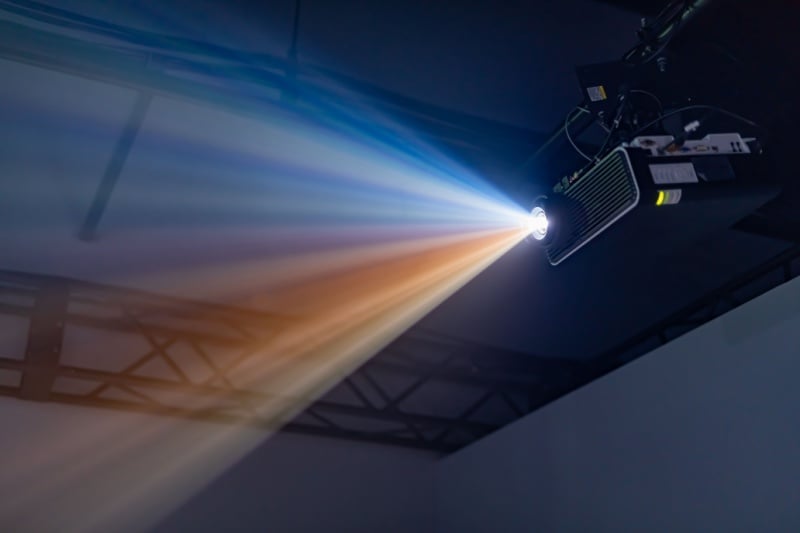
The switch to digital projectors began in the early 2000s. Movie distributors wanted theaters to switch to digital projectors to decrease the cost of manufacturing and shipping thousands of 35 mm films to theaters. So it was actually for financial reasons and not due to any failings of 35 mm film that digital projectors began to dominate the industry. Theater owners were hesitant to switch to digital due to the expense of upgrading their projectors, but they were pressured by the distributors to make the switch and were assured that the picture quality would be superior, making it easier to fill theater seats. Digital projection did offer more consistent image quality compared to 35 mm film: Sometimes, poor handling of 35 mm film resulted in scratches and other wear and tear damage. The switch to digital also make work easier for projectionists: Rather than handling heavy cans of film that needed to be loaded on and off of platters, digital film files were simply loaded onto a hard drive.
Movies could now be loaded to play in several auditoriums at the same time with the click of a mouse. Digital projectors also allowed the projection booth to be fully automated. Now, there was no need to have a projectionist start films, since the movie start times could be programmed to start automatically.
By 2015, the majority of theaters in the United States had gone fully digital. Unfortunately, some small, independent theaters were forced out of business because the cost to switch to digital was too high. But there are still some theaters that show classics and older films on 35 mm for cinephiles who enjoy that type of nostalgia. Projection technology will continue to evolve in the 21st century, but the all of the benchmarks and achievements throughout the history of movie theater projection should never be forgotten.